So here's the thing.
I'm a big fan of the Back To The Future films (BTTF was one of my most-watched films growing up). I always found it disappointing when Claudia Wells never came back to do the sequels, so the role of Marty's girlfriend Jennifer was filled by Elizabeth Shue. She does okay in the role, but she's not that great.
I've always thought they did a pretty good job in reshooting BTTF's final scene for the opening scene of BTTF2 with the new Jennifer. Which is why I thought it was pretty cool when I came across this rather great video on YouTube, presenting the final scene from BTTF and the opening BTTF2 scene simultaneously. And it's pretty interesting just to notice how much the pacing of the scene (subtly) changes between one version and the other - one film lags behind the other, then suddenly overtakes the other, and so on. It's also surprising to note that Michael J Fox actually introduces an extra use of the word "man" in the sequel.
Anyway, I just love that someone's done this - largely because it's the type of thing I wish I had thought of doing. Enjoy.
17 July, 2008

14 July, 2008
What do you think? Think they stand a chance?
So here's the thing.
I sat down a couple of weeks ago to watch Funny Games, the original German-language film by Austrian director Michael Haneke. My reason for watching it was quite simple - Haneke himself has recently made a shot-by-shot remake of the film, this time in English, with Naomi Watts and Tim Roth. I quite liked the trailer - a nicely effective trailer that in its last half reminds me of the trailer for A Clockwork Orange (which is itself possibly the best trailer I've ever seen). And there is something appealing about a director trying to absolutely replicate his own film - obviously there have been directors who have remade their own films (Hitchcock made two versions of The Man Who Knew Too Much, for example), and there have been shot-by-shot remakes before (Gus Van Sant's remake of Hitchcock's Psycho, which was really awful, and which changed just enough in the film to even render its shot-by-shot status questionable). But the idea of someone returning to a 10-year-old work and trying to absolutely replicate every detail (probably in order to try and reach an audience that wouldn't watch a subtitled film) was interesting to me. Would different casting, different languages, even just an older director, cause the film to feel different to the original? It will be interesting to find out.
 So, when the Film Festival programme came out, and the remake was in the listings, I knew I had to see the original film first. Especially since I'd started hearing comments that made me uncomfortable about seeing the film. I'd heard it compared to torture porn films like Saw or Hostel (a genre I find terribly offensive), comments about people feeling sick watching it, unable to watch it. On the other hand, I had heard reports about the violence in the film being largely off-screen or very fast, over before you even see it. Which made me curious as to how a film can be that disturbing if you don't even see it. Besides, I wasn't sure whether I would actually be able to watch this film once, let alone twice, and if I was to watch the original before the remake (which I wanted to), I had to watch the original film before festival tickets went on sale, because I didn't want to buy tickets for the remake and then discover I didn't want to sit through it again.
So I watched it.
And I thought it was ... interesting. It is a very challenging and disturbing film, and has stayed with me over the last few weeks. I don't really know whether I want to sit through the film (or at least a close facsimile of it) again, but I know I can make it through the film, so I did buy tickets for the remake. But the thing I found really interesting about the film wasn't actually in the film - it was actually an interview with Michael Haneke that was included on the DVD. And some of the things he said really bothered me.
The film is about this really nice family - a wife, husband, and young son. They're very happy together, live a good life, evidently fairly wealthy, and just generally have pretty much that any of us would want. Then one afternoon, they drive up to their holiday home looking forward to a week away. Not long after they arrive, a couple of polite, clean looking youths come around, initially asking to borrow some eggs. But it very quickly becomes evident that these people are planning to torrorise the family, betting that within twelve hours, all three family members will be dead. Let the games begin.
(Just a note - from this point, I'll be discussing the film's content. While I'm going to try and be as vague as possible about the details, there will be general spoilers how the film develops.)
Haneke starts to play his hand very early, working to make the audience complicit in the events of the film. At first you're not quite sure whether it is actually happening - the youths break the fourth wall for a split-second, seem to look at the camera (a big no-no in filmmaking) but it's so fast that you're not quite sure if you really saw that. Then, after the youths make their bet with the family, the lead youth actually addresses the audience, asking whether we think the family have a chance, noting that we're probably on their side. It's an unsettling moment, an indicator that the fourth wall will be broken fairly frequently throughout the film, constantly reminding us that this is a film.
But one of the problems the film has is that, because it is so well established within the film itself that it is a film, it stops working as a piece of drama. This really becomes evident takes place as we start the final third of the film. The youths vanish, actually leave the property, allowing one of the family members to try and escape. It's not much of a surprise that they recapture that person - what is surprising is how close they actually allow that person to get to being rescued. That person actually would have been rescued had they made one decision differently. There is no way that the youths would ever have done what they do - they basically surrender all control of the situation. It literally only works because it is scripted to work. And that really undercuts the film a lot. (Even moreso a later event, but I don't want to spoil that development for anyone that sees the film.)
But the other problem is that I'm not entirely certain that Haneke actually knows quite what he's done here. The film would be a lot worse, more harrowing, more disturbing, might actually achieve what he wants it to achieve, if he didn't have his characters making their aside comments to the camera. Because film to a large part is about forgetting that you're watching a film - you get drawn in, the people become real people, you empathise with their sufferings, you're happy when they're joyful. But with Funny Games, although Haneke is constantly trying to make us complicit in the torture - these events are only happening because we the viewers are watching them and are entertained by them - in fact what happens is that they stop being real people who are suffering, and instead become fictional people, and why should I be bothered by the suffering of people who don't exist? Haneke's efforts to make us complicit actually undercuts his whole message.
Haneke's attitude is basically that the film is almost a test. If you turn the film off then you pass the test. If you make it to the end of the film, then you need to hear what he's trying to say. And what he is trying to do is get us to question why we get so much enjoyment out of watching people suffer. Which is all very fine, but he's actually trying to criticise and condemn the viewer for watching the film that he made. In fact the film that he made was intended to cause us to suffer - Haneke has admitted trying to brutalise the viewer into realising how terrible it is that we watch this stuff. He has made a film to torture the viewer to tell us off for wanting the characters to suffer.
But what I'm not sure Haneke quite seems to get is that the violence, the parts of the film that he's criticising us for are not the parts that we enjoy. Now, I'm not talking about horror films here, largely because Haneke's film doesn't really feel like a horror film. Funny Games feels a lot more like a thriller, albeit a more extreme thriller. And in your typical thriller, there may very well be scenes where people are scared, people are hurt, people are even killed. But that's not really the point of the film. That's all just scene-setting, establishing the situation, confirming the threat. Instead the point of the film is the suspense around the person trying to fight back. They have their life taken over by some intruding force, but there will be some moment where they decide to take it back. And that is the moment when your typical thriller becomes interesting, because suddenly its not about one person inflicting pain on another, its about a battle of wits between two equally matched people, and the suspense around who will win. That's what this film constantly feels like it's about to become, but it never does. Instead, the family suffer through the torture and the killing, trying occasionally to take the initiative, actually succeeding (or almost) once or twice, but it never develops.
Now, what I'm just said is relevant in terms of a thriller, because to my mind that is the type of film that Haneke has made. I suspect he was actually thinking about horror films, in which the evil is never really vanquished, and if you do happen to survive the first film, you'll probably be killed off in the sequel, clearing the way for new flesh. And I think there he's got some legitimate criticsm of those films, but this film does not feel like those films, partly I suspect because the violence is all offscreen. A horror film would show you the killings, the deaths, would go to great lengths to invent new means of killing that we haven't seen. This film doesn't do that.
 And having seen the original film, I think that's the really big failing with the idea of making a shot-by-shot remake. As an experiment, it's a fascinating idea - in fact, it was the thing that first caused me to be interested in the film. And I know Haneke actually wanted to make the original in America - he was speaking about American filmmaking - but he couldn't get the financing, so had to make it in German. Since he had some success in the US with Cache [Hidden], this has allowed him to try and make the film he originally want to make. But American filmmaking has moved on in the last ten years into ever more dark and scary areas. The rise of the torture-porn genre that really deal in the depths of human suffering and depravity, films in which the characters have no hope for anything but, if they're lucky, a quick death. To the degree that Haneke has a point in what he is trying to say, he's saying it to the people that watch this type of movie. The problem is that if you're trying to make a film to speak to the Saw audience, you need to be a lot more graphic, first to attract them, then to actually shock them enough to make your point. But since he's trying in effect to present an exact copy of the first film, that's a big constraint that limits his ability to do what needs to be done in order to achieve what he's trying to achieve.
Now, what the film does do, and do very well, is show you the true cost of what happens on the family. There is a scene immediately after one of the family is killed (off-screen). The blood is splattered all over the TV screen. The camera cuts to a wide shot, we can see about half the lounge, and in the far end over by the wall, we see one of the family members (I won't say who). That person sits still for a moment, afraid to move, then gets up and moves to the TV, rubs against it until they cut through their bonds. They then stand up and cross the room, the camera pans to follow them, still at a wide shot. They stop at the door, go back to the middle of the room, help the other surviving family member to stand up, and then walk back to the door and out of the room. That's all that happens in the shot. The shot takes just over ten minutes. Ten minutes. That is a long time for such a small amount of action to play out. But it's very realistic - they've just seen someone from their immediate family killed, they're traumatised by that, they're afraid that the killers might attack them at any moment, they're physically exhausted (it's been a long night), they're tired and sore, every step they take is agony, they feel on the verge of collapse. It's realistic that people in a situation like that would take that length of time. So what the film does do, and does really well, is present the emotional toll that these events would have on the people.
But I think the thing that really made me angry was a comment Haneke made about the audience's reaction to one scene. There's an incident late in the film where, for a moment, it seems like the family are going to get the upper hand. In fact, one of the youths is actually killed, on-screen. For real. Dead. And then ... something happens. I'm not going to tell you what, and you'd never guess what it is, but it's an astonishingly audacious thing for Haneke to do. David Lynch would reject the idea for being too out there. But here's the problem. Haneke talks about being in the movie audience when that death takes place. People cheered at that death, and then when this subsequent event takes place, they realised what had just happened. They had just cheered a murder. And the way Haneke talks about it, it's this whole attitude of how terrible that is. And that, I'll be honest, really made me mad. Because I don't like the idea of some European telling me how bad it is when someone kills someone else in self-defence. This was not an unprovoked murder. These people had already killed one person, they had openly stated their intention to kill the other two family members. And perhaps it's just me, but I can't conceive of how anyone could have any moral problem with that killing - it is the clearest situation of a justified killing that could be concieved. Kill or be killed. And if (as I would argue) there is no moral problem with that killing, then I don't see why there should be any problem with an audience being happy and relieved, even glad about the fact that it had taken place. Because we like these people, we're not actually enjoying watching them being tortured, we want them to make it out of the movie. And if them surviving requires that they kill the people who chose to inflict such treatment on them (which it does), then so be it. I see no problem with that.
But then, that's just me. And I'm generally pretty vindictive.
Haneke is a brilliant director, no doubt about it. He managed to make a phenomenally disturbing, harrowing, sickening film with barely any onscreen violence. Hell, the film had an R18 rating for "graphic violence", yet there was only one incident of actual violence I can think of in the entire film, it's over in a flash, and I've seen worse violence in lower rated films. The film feels a lot more violent than it is. I know I'll be able to make it through the festival screening of the remake, but I'm really not looking forward to it. A lot of it is the film itself, which really is an intense and unpleasant experience. But a lot of what I hated about the film came from Haneke and his whole attitude of judging the audience watching his film. I was talking to a friend at work who I knew had seen the original film, and he said he found Funny Games to be rather an immature work. He suggested that Cache was a more reasoned and honest exploration of many of the same issues, which sounds good - I must try to see that.
But Funny Games? It's a well-made film, but certainly one of the most difficult films I've ever seen. I'm just glad I'll have had four weeks to recover from the experience before seeing the remake.
I had a lot of other things I wanted to say about the film, but it's taken a few weeks for me to get this far into the post, and I honestly can't be bothered working any more on it. I might talk a bit more after seeing the remake, then again, I might not. We'll see.
09 July, 2008
I don't want to do this...
So here's the thing.
I'm looking at eT's Slightly Intrepid blog, and I see he's posted one of those "answer a bunch of questions" things. And, horror of horrors, he's tagged me to do it next. Now, I hate these things, and normally when someone emails me one of these things, I just ignore it. But this time the challenge is out there, in public, on the internet, for everyone to see. So I feel that I really do have to respond.
So here it goes...
What were you doing ten years ago?
I was halfway thought my third year of university, having just completed my final paper for my commerce degree, and with 1½ years to go on the law degree. Since we're talking about early July 1998, I suspect I was probably in Wanganui at the time, since it was would have been university holidays.
Five snacks I enjoy in a perfect, non weight-gaining world:
- Rocky Road icecream (strawberry or caramel, I'm not picky)
- Cadbury's Black Forest Chocolate
- Roast Chicken, Lemon, and Thyme chips (I forget the names of the people who make these, but they are good)
- Donuts (why is it so hard to find donuts anywhere in Wellington? I'll help eT open a Wendy's in Wellington, if he'll help me open a Dunkin' Donuts or Krispy Kreme)
- Mrs Higgins Raspberry and White Chocolate cookies
Five things I would do if I were a billionaire:
A few years ago, I know what my answer would have been - invest in movie versions of the Narnia books. But since they're being made now, that option is a bit pointless (although if the series ends before they film all seven books, as they probably will, I would invest in any unmade films).
I know I should use the money to do things for the benefit of all mankind, spreading the Gospel, etc, but if I'm honest with myself, it would probably be more along the lines of:
- Get a great home theatre setup - colossal screen, earth-shaking sound system, that type of thing.
- Buy a Porsche 911 (I'm not a car person at all, but after watching Top Gear for a while, I'm starting to realise the Porsche 911 is a beautiful car.
- Travel - particularly the UK, Europe, China, and I'd quite like to visit Israel as well. Plus I would keep going back to Disneyland again and again, just because it's Disneyland.
- You know how Daniel Plainview had his own bowling alley at the end of There Will Be Blood? My own bowling alley would be quite fun, only without the corpse lying across the lane.
- Carry on working (I hope), just because I think the idea of never working again actually sounds rather awful.
Three of my habits:
- Setting both my alarm clock and cellphone alarm for 7.00am, getting up, hitting snooze on both, getting up at 7.06am to hit snooze on my cellphone, getting up at 7.09am to hit snooze on my alarm clock, getting up at 7.12am to hit snooze on my cellphone, getting up at 7.18am to hit snooze on both my cellphone and my alarm, getting up at 7.24am to hit snooze on my cellphone, getting up at 7.27am to hit snooze on my alarm clock, getting up at 7.30am to hit snooze on my cellphone, getting up at 7.36am to hit snooze on both my cellphone and my alarm, getting up at 7.42am to hit snooze on my cellphone, getting up at 7.45am to hit snooze on my alarm clock, getting up at 7.48am when my cellphone goes off again, turning my cellphone off, finally up and ready for the day. Then having a shower, getting out to realise my alarm clock is still going since I last hit snooze on that one and forgot to turn it off. By which point I'm usually running late and end up having to run to catch the train. I hate mornings.
- Forgetting stuff. Lots of stuff. It's a rare conversation where I actually manage to make it through an entire conversation without at some point forgetting mid-sentence what I was saying, and usually even the whole topic of conversation. If I'm like this now, with a youthful alert mind, I hate to think what I'll be like when I'm old and senile.
- Telling a very long, complicated, and detailed story, only to realise at the end of the story that it was actually pretty boring and not much actually happened and if I'm bored by the story I'm telling how boring must it be to the person I just inflicted it on.
Five jobs that I have had:
Ignoring my current job, here is my entire work history
- Delivering Avon pamphlets every three weeks for my aunt.
- Woolworths checkout operator for six years.
- Health Benefits three times during university holidays - mostly data entry, prescription processing, and in my last year, warehouse worker (I was working in a building that stored every prescription written in New Zealand in the previous two years - they would send me a list of specific prescriptions they wanted, and I would have to find them)
- Some plastics factory - I can't even remember the name of the place, but we would make shoe soles and Kiwi Cricket tees. I was no good at the job, and was fired after two weeks - they said it was because one of their major purchasers had closed down, so they didn't have any work for me any more, but I never believed them, because I know how bad I was at the job.
- Six weeks as a painter at a (now closed-down) saw mill. The mill had been operating in the US, dismantled, shipped, and rebuilt in Wanganui by the owners. It was my job to paint all the machinery. Very hard job, long hours (11 hours a day, starting at 6.30am (I can't believe I did that?), plus a half-day on Saturday), all for minimum wage. Plus the guy I had to work with was the most unpleasant, ignorant, and stupid person I have ever met (I particularly remember one argument we had where he argued the time on his watch was more accurate because he used hs neighbour's sundial(!) to set the time.) Plus, he was extraordinarily lazy - I remember he used to take pride in managing to keep his overalls clean. And there's only one way a painter can not get paint on himself, and that's by not painting. I was very glad when the university year started again and I could leave, never having to see him again.
Five things to do today:
- Write these bloody reports (not very exciting, but it's what I need to do)
- Rewatch the Doctor Who finale, this time with the MP3 commentary track
- Do some more work on my Funny Games post - since I've already mentioned I'm writing it, I'm committed to actually finishing it, although it's a hard post to write since I just start getting angry every time I work on it.
- Yawn a lot, complain how I'm not getting enough sleep, then stay up until midnight playing Lego Star Wars because I'm still young and don't need to go to bed earlier. (This, incidently, also gives rise to one of my habits.)
- Feel extremely envious at eT for getting to go to a garden party at Buckingham Palace.
Five people I want to get to know more about:
- Terry Gilliam (Monty Python animator and great film director)
- Joel and Ethan Coen (it's very nice to be able to describe them as Oscar-winning directors)
- Tom Baker (the Fourth Doctor, Little Britain narrator, and an entertaining storyteller)
- Ira Glass (host of the This American Life radio show)
- Edgar Wright (writer/director of Shaun of the Dead and Hot Fuzz)
People to tag:
No-one - since I really do hate these things, I don't want to try to oblige anyone else to answer it. But if anyone reads this post and decides to do their own list, feel free to do so and post a comment pointing to it.
There we are. How did I do?
04 July, 2008
Rosebud
So here's the thing.
I just wanted to write a brief post about a couple of things I'm excited about.
 Firstly, possibly the most important discovery in film history. I first saw Metropolis about five or six years ago, when the Film Festival showed the recently restored version. And the film, an extraordinary silent film from 1927 about a futuristic society, class divide, a worker uprising, and one of the most famous robots in cinematic history, just blew me away. Not only is it an enjoyable story, but the design and look of the film is incredible, and there is a scope and size to the film that is quite mindblowing, with some effect sequences that still hold up today.
The sad thing is that the film only played briefly in its complete version, before having cuts. The restored version that I first saw was still missing nearly a quarter of the original footage - they covered the gaps with cards detailing what happened in the missing scenes. It was an elegant solution that worked well - especially since, being a silent film, we're already watching cards for any dialogue, so no real adjustment is needed. But still, some of the scenes described sounded interesting, and so it was frustrating whenever one of those cards appeared because you would just find yourself thinking "I want to see that."
So you can understand why I'm excited. It was announced yesterday that a copy of the complete film with all the missing scenes has been discovered in a film museum in Buenos Aires. From the pictures available of the footage, it looks like it is badly scratched (and although there will obviously be restoration efforts, who knows how clean they'll be able to get it), and it is from a 16mm print (so there will be an obvious quality drop from the 35mm footage), but who cares. We'll be able to see Metropolis complete for the first time in 80 years. And that is exciting. Plus, Kino have since confirmed that they will be including the new footage in their already-announced Blu-Ray release, scheduled for next year. That's one release I'm really looking forward to.
(EDIT: It now seems it may not quite be complete. It seems there is still one scene missing - apparently it was at the end of a reel and was badly torn. But otherwise, complete!)
Now, did anyone check whether the Museo del Cine had a copy of The Magnificant Ambersons?
 The other thing I'm excited by is just something cool I came across on on the Guardian website. It seems Channel 4 in the UK is having a season of showing Stanley Kubrick films. As a fan of Kubrick, I'm in favour of anything that allows people to discover the man's work. And they're clearly going all out to promote the season. Witness this ad, purporting to present Kubrick's point-of-view as he walks through the set of The Shining, past the twins, past someone painting REDRUM on a door, dodging extras practicing their ballroom dancing, through the snow-covered hedge-maze, to finally sit down at his chair, about to direct the very scary Danny-on-a-tricycle scene. And the recreation, to my eye at least, looks perfect. The attention to detail is stunning, the look-alike actors seem convincing, and the presentation of the behind-the-scenes world seems faithful to how it was presented in the documentary shot by Kubrick's daughter on the Shining set. It's a brilliant ad, and I hope it succeeds in bringing attention to the season, introducing Stanley Kubrick to many people who have never seen his films.
By the way, apparently they're starting with a new documentary, Citizen Kubrick. This interested me, and when I Googled the title for information, it seems it's based on this Guardian article from 2004. I've read the article a few times in the past, but it's always a delight to reread. Two years after Kubrick died, Jon Ronson was invited to the Kubrick house, and the story reveals Kubrick's obsessive attention to detail. (In my favourite part of the article, we discover that Kubrick keeps an archive of fan letters arranged by city, so that if one of his films is shown somewhere, Kubrick can arrange for one of those people to check the quality of the movie screen.) It's a fascinating insight into who Kubrick was, and the idea of a documentary based on that article is rather exciting.
03 July, 2008
There’s dangerous work to do
So here's the thing.
I went to see the new Speed Racer film in the weekend. And judging by the number of people in the cinema (maybe 20 people at the main Saturday night screening in the film's opening weekend) the film is going to bomb here just as much as it crashed and burned in the States.
 Which is a shame, because Speed Racer is possibly the most insane film I’ve ever seen. I'm not really saying it’s a good film, but my gosh is it a lot of fun. It's an absolute must-see on the big screen, but since most people won't see it on the big screen, I'm just glad it has been made in the high-definition era where Blu-Ray can at least attempt to replicate the experience.
I will confess I wasn't all that interested in the film initially. I watched the show as a kid, but the only thing I remember of the show is the title character (if you showed me a picture of him, I would have recognised him) and the title song (Here he comes! Here comes Speed Racer! He's a demon on wheels!). None of the other characters remained in my memory; in fact I remembered the show so little that, after seeing the trailer, I had to check Wikipedia to discover that there really was a chimp in the TV show. Mainly I just remembered the show as a rather silly forgettable Japanese animated show, and the idea of a live action film seemed a little absurd.
That changed when I first saw the trailer. Here was a garish, hyperactive world in the brightest colours visible to the human eye. Here was an insane world unbound by any rule of physics. Here was an animated world brought to real life, and then completely reworked because it just wasn't sufficiently ridiculous. I fell in love with the trailer, and eagerly looked forward to the film. I wasn't surprised when the film got bad reviews, but I was disappointed when the film completely flopped on release in the States (costing $120 million, it made only $18.5 million in its opening weekend, and even now, nearly two months after release, its worldwide gross is still only $83 million).
And to some degree, I can understand it. There is no substance to the film – characters have all the depth of Saturday morning cartoon characters, and the plotline (Racer has his idealism shattered after discovering his beloved sport is filled with corruption) is not that impressive. As a result, you very quickly learn that any time away from the racetrack feels like wasted time. You never get a sense that it is actually devastating for Speed to discover his all-time-favourite race was fixed, so it's hard to really care. Plus there's the whole backstory of what happened to Speed's brother Rex, which is presented in small snippets through the film, until you want to scream "Just tell us already!" Plus there is the question of Racer X. Matthew Fox gives one of the best performances in the movie, but the film drags out the mystery of his identity far too long. Now, I admit that I knew going into the film who his character was (having discovered it when looking the show up on Wikipedia after seeing the trailer), but the way the film overplays the big mystery I suspect I would have figured it out long before the big reveal. So, to be honest, as storytelling the film is a failure.
But as an experience? As spectacle? The film is quite extraordinary. There's a bold quality to the look of the film – in fact, for the first five or ten minutes, while my eyes were adjusting, I was constantly rubbing my eyes, having difficulty coping with just how bright the film was (my gosh, I have old man eyes). I described it as "garish" earlier, but that term is a negative description that is actually unfair to the film. There is just a mess of colours in every frame, all competing with each other, that it becomes almost ... beautiful isn't the word. Striking, perhaps? Just look at this frame. There is no way it should work, but yet it does, somehow.
As for the action, the race scenes that are the core of the film? There the Wachowskis seem to be just taking the current popularity of the fast cut to extremes. With the kind of hyper-world they're presenting us with, it takes time to actually look at what they're presenting, actually just take in what we're looking at. But the Wachowskis seem determined to deny us this. Instead, they seem to be pushing to discover the shortest possible cut they can make to each shot without sacrificing cinematic coherency. I realise some have argued they don't succeed, but personally, I thought it worked. The film's race scenes always seem like they're about to collapse into incomprehensibility, but they never actually cross the line. The result is that the race scenes are actually enjoyable, in a strange way. I don't know why, but I liked them.
The film ultimately becomes an exercise in excess. The Wachowskis seem to be asking, "How much can we get away with." And the answer, at least from my point of view, is: a hell of a lot. It's big, absurd, and audacious. No-one's ever going to say they lacked imagination with this one. I'm not going to argue it's a great film. I'm not even going to argue that it's a good film. It just is what it is – a live-action Japanese cartoon for children. But, and I'm a bit ashamed to say this, I really enjoyed it. And don't be surprised if this time next year I own the film on Blu-Ray. I'll just tell people it's a demo disc ... yeah, that'll be my story.
I went to see the new Speed Racer film in the weekend. And judging by the number of people in the cinema (maybe 20 people at the main Saturday night screening in the film's opening weekend) the film is going to bomb here just as much as it crashed and burned in the States.
 Which is a shame, because Speed Racer is possibly the most insane film I’ve ever seen. I'm not really saying it’s a good film, but my gosh is it a lot of fun. It's an absolute must-see on the big screen, but since most people won't see it on the big screen, I'm just glad it has been made in the high-definition era where Blu-Ray can at least attempt to replicate the experience.
I will confess I wasn't all that interested in the film initially. I watched the show as a kid, but the only thing I remember of the show is the title character (if you showed me a picture of him, I would have recognised him) and the title song (Here he comes! Here comes Speed Racer! He's a demon on wheels!). None of the other characters remained in my memory; in fact I remembered the show so little that, after seeing the trailer, I had to check Wikipedia to discover that there really was a chimp in the TV show. Mainly I just remembered the show as a rather silly forgettable Japanese animated show, and the idea of a live action film seemed a little absurd.
That changed when I first saw the trailer. Here was a garish, hyperactive world in the brightest colours visible to the human eye. Here was an insane world unbound by any rule of physics. Here was an animated world brought to real life, and then completely reworked because it just wasn't sufficiently ridiculous. I fell in love with the trailer, and eagerly looked forward to the film. I wasn't surprised when the film got bad reviews, but I was disappointed when the film completely flopped on release in the States (costing $120 million, it made only $18.5 million in its opening weekend, and even now, nearly two months after release, its worldwide gross is still only $83 million).
And to some degree, I can understand it. There is no substance to the film – characters have all the depth of Saturday morning cartoon characters, and the plotline (Racer has his idealism shattered after discovering his beloved sport is filled with corruption) is not that impressive. As a result, you very quickly learn that any time away from the racetrack feels like wasted time. You never get a sense that it is actually devastating for Speed to discover his all-time-favourite race was fixed, so it's hard to really care. Plus there's the whole backstory of what happened to Speed's brother Rex, which is presented in small snippets through the film, until you want to scream "Just tell us already!" Plus there is the question of Racer X. Matthew Fox gives one of the best performances in the movie, but the film drags out the mystery of his identity far too long. Now, I admit that I knew going into the film who his character was (having discovered it when looking the show up on Wikipedia after seeing the trailer), but the way the film overplays the big mystery I suspect I would have figured it out long before the big reveal. So, to be honest, as storytelling the film is a failure.
But as an experience? As spectacle? The film is quite extraordinary. There's a bold quality to the look of the film – in fact, for the first five or ten minutes, while my eyes were adjusting, I was constantly rubbing my eyes, having difficulty coping with just how bright the film was (my gosh, I have old man eyes). I described it as "garish" earlier, but that term is a negative description that is actually unfair to the film. There is just a mess of colours in every frame, all competing with each other, that it becomes almost ... beautiful isn't the word. Striking, perhaps? Just look at this frame. There is no way it should work, but yet it does, somehow.
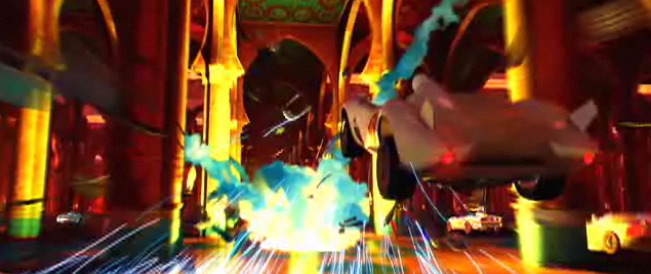
As for the action, the race scenes that are the core of the film? There the Wachowskis seem to be just taking the current popularity of the fast cut to extremes. With the kind of hyper-world they're presenting us with, it takes time to actually look at what they're presenting, actually just take in what we're looking at. But the Wachowskis seem determined to deny us this. Instead, they seem to be pushing to discover the shortest possible cut they can make to each shot without sacrificing cinematic coherency. I realise some have argued they don't succeed, but personally, I thought it worked. The film's race scenes always seem like they're about to collapse into incomprehensibility, but they never actually cross the line. The result is that the race scenes are actually enjoyable, in a strange way. I don't know why, but I liked them.
The film ultimately becomes an exercise in excess. The Wachowskis seem to be asking, "How much can we get away with." And the answer, at least from my point of view, is: a hell of a lot. It's big, absurd, and audacious. No-one's ever going to say they lacked imagination with this one. I'm not going to argue it's a great film. I'm not even going to argue that it's a good film. It just is what it is – a live-action Japanese cartoon for children. But, and I'm a bit ashamed to say this, I really enjoyed it. And don't be surprised if this time next year I own the film on Blu-Ray. I'll just tell people it's a demo disc ... yeah, that'll be my story.
24 June, 2008
Suspense, laughter, violence, hope, heart, nudity, sex, happy endings... mainly happy endings
So here's the thing.
I found myself standing outside at 7am this morning, in the cold, wearing a heavy jacket and gloves, and listening to my iPod, waiting sixth in queue for the ticket office to open at 8am. Yay for the film festival!
This was the second year I've actually queued and waited for tickets to go on sale. And although it's really hard to get up that early (it's just unnatural to be up at 5.30 in the morning) and it means incessant yawning for the rest of the day, it's worth it to be guaranteed good seats, perfectly centred to the screen, in the nice comfortable plush seats at the Embassy or in the (only) comfortable seating section in the Paramount (Really, why don't they hurry up and install those seats in the rest of the cinema?).
Anyway, the films I will be going to see are:
- Man On Wire
- Married Life
- Rain of the Children
- In Bruges
- The Red Balloon/White Mane (just because I've never seen The Red Balloon, and it's one of these films everyone says you should see)
- Earth
- Persepolis (this is the film I was most excited to see in the festival)
- The Counterfeiters (won the Oscar for Best Foreign Language Film)
- Bigger, Stronger, Faster* (and yes, the asterisk is part of the film title - no idea why)
- Lorna's Silence
- Taxi To The Dark Side
- Be Kind Rewind
- Funny Games (this is a shot-by-shot English-language remake, by the same director, of a German-language film from 1997. I watched the original in the weekend, and have started working on a post about that film.)
- The Adventures of Robin Hood (Errol Flynn and Basil Rathbone swordfighting on the big screen!)
- Mongol (an epic about Genghis Khan. Should be great on the Embassy screen.)
- Standard Operating Procedure
- The Wave
- The Escapist
- Crazy Love
- The Savages
- The Freshman (this is the Live Cinema screening this year - a Harold Lloyd silent film with the Wellington Vector Orchestra providing live accompaniment)
I believe that, with 21 films, this is probably the most films I've ever been to in the festival. (I'm pretty sure I've never broken the 20 film mark before.) There is one day where I have four films in a row, so that will be a challenge. (There was a fifth film I was considering for that day, but I thought five in one day would just be too much, especially since that final film would be subtitled, and I would be much too tired for subtitles.)
Anyway, it's going to be exciting. 24 days to go.
16 June, 2008
The flames rise high into the night
So here's the thing.
 Perhaps the most surprising thing about Shine A Light, the new film directed by Martin Scorsese, is the realisation that Scorsese hasn't made this film before. The movie is basically a concert film, recording a single live performance* by the Rolling Stones at the Beacon Theatre in New York in late 2006. And looking at Scorsese's 35-year film career, it's surprising that it has taken this long for him to film the Stones. After all, the Rolling Stones' music is an integral part both in Scorsese's life and his films, and Scorsese has real experience with concert films, having worked as an editor on the Woodstock movie, as well as directing The Last Waltz (the highly praised film of the final concert by a band I've never heard of called The Band). And now, Scorsese has finally filmed the Stones, and while you would never say that this is the culmination of his career, in a lot of ways you can tell that this is a movie he's dreamed of making all his life.
* The soundtrack CD also includes three songs recorded at a concert two nights earlier at the same venue, but none of those songs are in the film.
The film starts with a nice little arrangement of footage of the planning and preparation, both for the concert and for the film. And it's a real delight, with arrangements being made between the parties in different cities, in different countries even, no-one quite sure who made what decision. Serious concerns are expressed that the lighting for one piece might actually set fire to Mick Jagger (Scorsese unequivocably states that they cannot set Jagger on fire). Pretty much every review I have read of the film highlights the multiple scenes where Scorsese tries unsuccessfully to get a confirmed set list out of Jagger, and with good reason. It's an illuminating scene, showing the clash between a director who needs to plan, and a band that after 45 years together know how to improvise and completely alter the set list during the show itself, based on how the crowd feels. Scorsese has to plan for a wide variety of songs that could be performed, but many of which will not, categorising the different songs into "definitely perform", "will probably perform", "good chance will perform", and "may perform".
Meanwhile, the Stones come across as the old hands that they are. While it is clear that they put a lot of preparation into their concerts, they know what they're doing, and the performance tonight is just the most comfortable thing in the world. The one thing that seems to make them uncomfortable is all the schmoozing that comes with the job - they meet Bill Clinton, and then discover they'll have to come back later to meet 30 guests of Clinton, and then they have to wait for Hillary's mother to arrive late.
Meanwhile Scorsese's inability to get a setlist from the band is clearly driving him insane - at one point he seems to give up on getting a confirmed set list, or even just confirmation of which song will be played first, he just wants to know which instrument will start playing first just so he knows who to actually focus all cameras on. This all builds to a climax with the show about to start in five seconds four three two Scorsese gets the set list "First song!" and BAM with a burst of guitars the show starts.
It's impossible to actually express how thrilling that entire opening sequence was. It's brilliantly concieved and executed, and quite essential because it actually gets you in the right mood for the film. If you go to any kind of performance, the moments right before it starts are really very intense. You've had your tickets for months, you've been looking forward to this day, you've built it up so much in your mind, and finally you're actually there, it's all going to start in five minutes, and you watch your watch, and finally the scheduled start time arrives, and it passes, it was supposed to start one, two minutes ago, it could start any moment now, and finally the lights dim, you see movement on the stage, you might hear an announcement, and finally the stage lights go up and the rush, the "This is it" thrill is incredible. An ordinary filmed recording of a concert would not have that same rush of anticipation as the performance starts - you couldn't do it. And so Scorsese uses the whole buildup to the show and to the filming as a way of achieving that same excitement. Will Scorsese get a set list, will there be any last minute problems, and these concerns build up so when they reach a point five seconds from the first notes, you have that same sense of "What is going to happen? Will this work out?" It may not be the same kind of rush you would get from a live concert, but it's a pretty good approximation. So when Jumpin' Jack Flash starts, you're prepared.
Now, this is the point where I probably need to make a disclaimer. I am not a Rolling Stones fan. I'm not saying I dislike their music - I don't - it's just that, as those of you who know me will know, I'm not a big rock music person full stop. I've never really listened to the Stones, I honestly don't know them. Of all the songs performed in the film, I actually only knew two (Start Me Up and Satisfaction) and had vague recollection of having heard a third before (Sympathy For The Devil). (The soundtrack CD also included a third song, Paint It Black, that I also know, but that's not in the film.) The rest were entirely new to me. As for the band members themselves, obviously I knew who Mick Jagger and Keith Richards were (everyone knows them), but I only knew who Ronnie Wood was because he was on Top Gear recently, and I didn't know who Charlie Watts was at all. That said... Wow.
Just over a month ago, I went to see U2 3D. And I really enjoyed that film, a lot. It was a great experience, what with the spectacle of a U2 concert, and the 3D giving a real "you are there" feel to the film. Shine A Light was very different. There was no spectacle, no giant screens, no collosal arena, no over-the-top theatrics. There were just four guys in their 60s, performing in a (comparatively) small theater to a crowd of less that 3000 people.
And Shine A Light was easily better. Because shorn of any add-ons, relying solely on their performances, the Stones really are incredible entertainers. Years of the rock-and-roll lifestyle may mean some band members look even older than their actual age (and, even on an ordinary non-Imax screen, every crease, every wrinkle on Keith or Mick's face is a clearly visible crevasse), but there is no sense of age in their performance. (If anything, Jagger and Richards seem an advertisement for the life-sustaining properties of the rock-and-roll lifestyle.) It's impossible to imagine that a performance by a young Jagger would be any different to the one captured in the film. He jumps, leaps, runs, dances with a vigour and an excitement that is tiring just to watch. And the rapport between the band members is something to behold. Every now and then, you'll get a very cool moment, where the band members just see each other, and just for a moment you get these guys grinning, seemingly still amazed at how cool it is that this is how they make their living. Forty-five years these guys have been touring and playing together, and it's never grown old. And that is cool.
One of the things the film really identifies is the role of the audience in the performance - without an audience, you're just playing, but with an audience, you're performing. With the U2 film, in addition to all the footage shot during many actual concerts, they got the band to do an entire concert to an empty stadium so they could get some of the shots without intruding on the crowd's view. And the more I think about that, the more it bothers me, because it reduces the playing of a song down to a purely technical level - this note then this note, this lyric then this one. Whereas, with Shine A Light, Scorsese seems determined to prove they didn't do anything like that, ensuring that the crowd is ever present - the camera is either down at crowd level, surrounded by people watching and enjoying the show, or it's filming a performer with the audience clearly visible in the background. In fact, it's difficult to think of a shot that could have been shot in an empty theatre. And that's a great thing, because the band clearly feed off the energy in the room. They're not focused on trying to give a good performance for the camera, they're focused on entertaining the crowd. And that just gives a natural real performance that happens to be fun to watch.
But while the focus of the film is absolutely on the Stones' performance, Scorsese does some nice work in inserting the occasional piece of classic footage - mostly old interviews from the 1960s to 1980s, but there's also the odd piece of news footage. And that's interesting, just because it really drives home how long these guys have been doing this. In the most amusing footage, an impossibly young-looking Jagger expresses surprise that the band has been going a full two(!) years, and hopes that this will go on for at least another year. (Although I was rather fond of the Japanese interview from the 1980s where the female interviewer, clearly struggling to think of any questions, asks Jagger how old he is). While the clips unfortunately lack context for those of us that aren't versed in Stones history (news audiences at the time would have known the background to Mick Jagger's arrest and eventual release, but I had to look it up), it's still a nice element that makes the film less of a filmed concert, more a part of the recorded Stones history.
I think the film really benefits from having Scorsese direct it. The challenge of trying to make this film must have been phenomenal - one single concert with no retakes, trying to construct it on-the-fly to work as a film while not intruding at all on the Stones' performances or the show itself. (Jagger, worried about ruining the crowd's enjoyment, expresses doubt about even including a camera that sweeps across the crowd to the stage, although he eventually relented.) The team that he put together was phenomenal, with some of the top cinematographers operating today (including Andrew Lesnie, who shot Lord of the Rings) shooting the concert, just to make sure that the images they got from the concert were as good as possible, since they won't get a second shot. And Scorsese's input is essential - the music of the Stones is so ingrained in him that he's completely in sync with the performances - every camera move, every cut and edit, is perfectly timed to work with the music, never cutting across the song. The challenge and pressure of trying to construct a film under these constraints really seems to have stimulated Scorsese, who really delivers a movie that is not just a filmed concert, but a genuine cinematic experience.
I guess the best way to sum up the film is by returning to compare Shine A Light with the U2 3D film. And what I find is this: U2 had a lot of advantages - a lot of song familiarity on my part, a lot of concert spectacle, and the general gimmick of a 3D film. And it was enjoyable, and I do recommend it. But, even if they could replicate the 3D element on a home entertainment system, it's not a film I could see myself owning. There is something lacking from the film, a spark, and I didn't realise it until I saw Shine A Light and saw that spark of life. Because this film had all the disadvantages: I only knew a couple of songs, and the concert lacked spectacle. But you don't need that when you have a band like the Rolling Stones, a band of phenomenal charisma and performance excellence, captured in a film filled with imagination and excitement. The film is seriously a highlight of the year for me. Strongly recommended.
11 June, 2008
Babette Ate Oatmeal

So here's the thing.
I'm looking at the New York Times website, and they had an article about how you can now buy T-shirts with headlines from the CNN website.
I'm not joking. CNN.com actually has a T-shirt store on the site, where you can currently buy T-shirts announcing things like "Teen calls prom 'most wasteful event'" or "Bo Derek battles illegal wildlife trade". But you need to be in quick, because you can apparently only buy a headline T-shirt for as long as it's in the "Latest News" list.
The T-shirts (available in black, white, or grey) carry the headline, as well as a date-and-time-stamp and the statement "I just saw it at CNN.com".
Here's what I want to know. Who on earth came up with this idea? How on earth do you come up with an idea like this? And why on earth would you spend money on something like that? The point of a headline is to tantalise the reader, make them think "I want to know what that article is about". But many of these headlines make no sense away from the actual article. You need to actually read the article to know that "Spike to Clint: We're not on a plantation" is about Spike Lee criticising Clint Eastwood for the lack of African-American characters in his Iwo Jima movies. But you can't read the article because it's not on the T-shirt, so the title just stays there, existing with no reason for being there. Most of the headlines are neither witty enough to be amusing, or sufficiently self-explanatory to work once they're off the website and onto a T-shirt. And in any case - it's a news headline. It gets out-of-date or irrelevant pretty fast, and within a week you're wearing last night's fish-and-chips paper.
Now on the other hand, if The Onion produced T-shirts, that would actually make sense, because Onion headlines are intended to be funny on their own - the accompanying article is just an extension of the joke. You don't need to actually read on to find headlines like "Way Too Much Raised For Bronchitis Research", "Museum Of Television And Radio Acquires Rare 'Caroline In The City' Episode", or "FCC Okays Nudity On TV If It’s Alyson Hannigan" funny. Because they're funny in and of themselves. Plus, since they're fake news, you never need to worry about being out of date. You see, these would work on a T-shirt. CNN headlines just do not.
10 June, 2008
Born under a bad sign with a blue moon in your eyes

So here's the thing.
Did you realise that today is the one year anniversary of the HBO airing of "Made In America", the final episode of The Sopranos. One year since every person in America simultaneously yelled out "What the **** was that?"
Now I've always been very clear on my view of what happens in that controversial final scene (and if you never watched The Sopranos, never saw the final episode, turn off your computer, take a week off work, go to the local rental store, hire the DVDs, watch them, and then come back. I will be discussing spoilers.)
A lot of people believe Tony died in the final episode. They point to the "Guy In Members Only Jacket" going to the bathroom, suggesting that, like in The Godfather, he's going to collect a gun. The reason for the sudden unexpected cut-to-10-second-black-screen is that Tony is suddenly dead, shot in the back of the head - the black screen and sudden silence is an example of Bobby's comment that when you die, you never hear it coming.
And it's an argument I've never bought. For a start, it's too obvious. Ending the story of a mafia boss with the boss dying? Too predictable, too cliched. And a lot of people cite The Godfather reference as proof. To me, that's never a convincing argument. There's no doubt that Chase loves the Godfather films, but not so much that he would end this, the programme he will be remembered for until he dies, copying the movie.
Personally, I've always seen the final scene as an extreme version of a life-goes-on ending. Throughout the run of the series we've always known, whatever happens, Tony Soprano was safe. He's the main character, and he's pretty much irreplaceable. There may have been some tension of how he will deal with any particular problem, but we always knew he was okay. We wasn't going to die, he probably wasn't going to go to prison (even if he had some close calls). He would just carry on being Tony. Even when Tony was shot at the end of the first episode of the final season, wounded so badly he ended up in a coma, we knew he was essentially safe. So we never had any fear about what would happen to Tony.
Until the final scene. Because we know that all bets are off. There are only five minutes to go, they don't need to protect their star character anymore. For the first time in the entire series, anything could happen. Tony could be killed. Tony could be arrested. Will Tony be fine, but something happen to someone else in the family? Or things could just go on as normal. What's going to happen.
And the final scene seems a strange choice for the show - there's nothing obviously significant about it, it almost seems mundane. Tony walks into an typical American diner, takes a booth, orders onion rings. Slowly the rest of the family arrive, first Carmela and AJ. But here's where David Chase is brilliant. He knows that we don't know whether Tony is safe, so suddenly we, the viewer, are looking at every single person we see in the scene with suspicion. Two black guys walk in, there's someone in a cap possibly hiding their face, someone glances over and seems to take an interest in Tony, is he a hitman, or just someone thinking "Didn't I see him on the news once?". Everywhere the camera looks, even in this inocuous scene of a family eating, we see a potential threat. So, possibly for the first real time in the entire run of the show, we actually sense what it really means to be in the mob, the constant danger, the constant risk. It's not quite that we've been put in the mind of Tony Soprano, as I initially thought, since Tony is actually quite relaxed in the scene. He's used to living with that danger, so he's learned not to be constantly looking over his shoulder (since living every moment like that would drive him crazy). It's more that, whether or not Tony is actually worried about it, the audience understands that that danger is always there.
And then we get the sudden cut-to-black-slience, sustained for 10 seconds. What does that mean? Let's imagine the scene executed somewhat differently - Tony sits there, talking to his family, Meadow comes in, sits down, the camera pulls back away from the family, their conversation fades away, and finally so does the image. If they had shot the scene like that, with a typical life-goes-on feel to it, this story has come to an end, but the characters continue. Most importantly, it has a satisfying everything's-going-to-be-all-right feel. And that would be completely wrong for the show, because, after all, everything's not going to be all right. Tony may not killed tonight, but there's a good chance at some time in the future he will be. The guy who was talking to the Feds may not give them everything they need for a prosecution, but one of these days they will have enough, and Tony will go to jail. Whatever happens tonight is irrelevant, because at some point in the future he's either going to be killed or arrested.
So to me, the sudden cut-to-black-silence was about making that point in a dramatic fashion that a traditonal fade-to-black ending would not. David Chase basically seems to be saying that life goes on, whatever happens it's going to end badly, but you're not going to see it because we can't follow these characters for the rest of their lives. All we need to know is that it will happen one day, the final scene sets up the two main options, and then Chase says "I've finished telling the story" at an essentially arbitrary point. And the fact that it's mid-scene is irrelevant - in fact, it highlights the fact that the endpoint is essentially arbitrary.
So that is how I interpret the scene and the ending. Until tonight, because I've just read this impressively in-depth 21,750-word analysis of the ending, which argues forcefully for a Tony-dies interpretation. (I came across it after Alan Sepinwall wrote a post in which he highlighted this analysis.) He does a great beat-by-beat analysis of the final scene, interpreting the POV shots. He also does some nice work in analysing the overarching themes of the season and where Tony's death would fit into that, examines the role played by Tony's coma dream, does a nice comparison with the death of Phil Leotardo, and goes back to the first episode of the season (Members Only) for further clues. It didn't quite win me over to his point of view, but it came close, and certainly had me questioning how I interpret the ending for the first time since the series ended. Anyway, it's a fascinating read, and if you're a Sopranos fan, it's worth reading no matter how you interpret the final scene.
01 June, 2008
Frozen donkey wheel

So here's the thing.
I was wrong about the season finale of Lost. Or at least, I'm pretty sure I was wrong - there certainly wasn't the big three-year jump I was expecting. Oh well.
Still, I have spent all that time the past few weeks thinking about the term "frozen donkey wheel", wondering where it had come from, what it could mean. And yet at no point did it occur to me that there might be an actual literal frozen donkey wheel in the episode - not in the actual scene that had the FDW codename (that would be the final revelation of who was in the coffin), but there was one pivotal scene of someone turning a frozen donkey wheel. And I never saw that coming.
I had thought about writing this post in the way Alan Sepinwall writes the posts on his blog, with brief introductory comments, and then full comments with spoilers on the main post page, so anyone that hadn't seen the episode would not be spoiled. But I spent a couple of hours last night working on trying to figure out how to do it, and I have no idea - the instructions on this site are impenetrable. So I'll just put the text here on the main page in a white font, and if you want to read my comments on the Lost season finale, just highlight the text. Sorry about the inconvenience. (I'll have a couple of non-spoiler comments down the bottom that you should be able to read without highlighting.)
[highlight from here] Okay, so there wasn't a big 3 year leap in time - if only because we learned in the final scene that a lot of bad stuff happened after the Oceanic 6 left the island. But there definitely was room for the island to have moved forward in time a shorter period - and the most likely candidate is 10 months, since Ben's flashforward in The Shape Of Things To Come, where he arrived in the Sahara in late 2005 with a bloodied arm and wearing a Dharma parka, clearly followed on immediately from the point where he used the frozen donkey wheel to move the island. If that's where he went to, it's very possible the island also moved to that point in time as well
So Locke was in the coffin. Not a big surprise - he was one of the most popular guesses - but it does raise interesting questions. What happened on the island once they moved it? What exactly did they move it to? How did he die? (There was a reference to suicide - did he really kill himself, if so why, if he was murdered, by who and why?) Why do the Lostees refer to him as Bentham, even when they're in conversation among themselves - preserving the lie, or somethign else? What was Locke doing off the island? And while I know there were definitely problems between the Oceanic 6 and Locke, why did no-one, not even Hurley or now-appropriately-aged Walt (man has he grown up) go to his funeral to say goodbye to someone who was once a friend? Plus, he's now the leader of the Others, which should be a good opportunity to get further insight into the island residents, especially mysterious unaging Richard Alpert. But more interestingly the fact that Locke is dead is a possible move towards the popular theory that Locke is actually Jacob. After all, he is dead in 2007 and will need to be taken to the island in that coffin. This obviously has strong echoes of Christian, who also arrived on the island in a coffin, and is now Jacob's mouthpiece. And, if we assume that the 50-year-old Adam-and-Eve skeletons they found in the Rape Caves back in season 1 actually do have some significance to the story (and Lindelof and Cuse have said they do), then there has surely got to be some point where characters actually travel back to the past. And if it happens, why couldn't the characters, trying to return to the island, accidentally travel into the past. Locke's body is therefore on the island back in the 1950s, where he is brought back by the island and becomes Jacob. So that's my new theory - I wasn't fully on board with the Locke/Jacob theory, but now I am, and that's how I think it will work out.
One of the things I love about the show is that the showrunners are totally commited to the show and its world, but they never lose sight of the fact that it's rather absurd. Witness the laught-out-loud exchange between Locke and Ben, "Is he talking about what I'm thinking about?" "If it's time travelling bunnies, then yes." In fact, that whole scene was pure gold, with Locke watching the video, then getting nervous about Ben loading the machine with metal just as the orientation video explicitly states "no metal in the machine".
The scene of the Oceanic 6 in the raft was surprisingly intense, as the showmakers played on our memory of the Others taking Walt in the season 1 finale. When the boat appeared in the distance, we knew the Oceanic 6 would be safe, but there was also Desmond and Lapidus also on the raft, and we didn't know what would happen to them. So there was real fear for those guys. Are these bad guys in the boat? Will they kidnap Lapidus or Desmond (who had only just survived drowning)? And then the most unexpected moment of the finale happened - Penny appeared. The Desmond/Penny is easily the best love story in the show, and their reunion was every bit as emotional and powerful as I had hoped. I was looking forward to their ultimate reunion, but was certainly not expecting it this early. But it makes sense - especially since Ben promised Widmore (in The Shape Of Things To Come) that he would kill Penny. What would happen if he tried to send Sayid, who was rescued by Penny and who will now know that this was actually Desmond's Penny. Watching that whole story play out should be fun.
I've long believed that Claire is actually dead, died in the house explosion (again, in The Shape Of Things To Come), and the Claire we've been watching is an island manifestation like Christian Shepherd. And her creepy appearance in Kate's dream seemed to me to be one further confirmation of that idea.
Yay for creepy appearances by undead Christian, this time to let redemption-seeking Michael know he could go, about a second before he died. (Interestingly, Walt doesn't seem to know his father is dead.) Also Yay for Hurley playing chess with undead invisible Mr Eko.
The revelation that Charlotte may have had some connection to the island was interesting - partly because it had me (in my trying-to-keep-on-top-of-possible-revelations mode) realising I couldn't remember what happened to Ben's girlfriend Annie. And when I went back and checked, it seems we never found out - she was just gone by the time of the purge. Now, it's not her, but for a moment I thought it might be, before I realised Charlotte is too young to be Annie. I've seen some people suggest she might be Ben and Annie's daughter, and that is an interesting idea. At the very least, even if she has nothing to do with Ben or Annie, she has some connection to the island, and just what that will be should be interesting to discover.
One final note. I did love the opening - the way the "Previouslies" end on Jack's "We have to go back" scene from last season's finale, then the episode proper picks up immediately from that point. I never saw that coming, but it was perfectly executed.
[stop highlighting]
The main thing was, it was an exceptional episode. There were no big game-changing shocks in the way the last two season finales had (the Portuguese monitoring station offering us a glimpse of the outside world, or the flash-forward revelation), but since we already knew how a lot of the story was going to end (with the Oceanic 6) or where they were heading towards, it was fascinating watching everything play out. Some exceptionally tense moments, a few nice character beats, genuine laughs, leaving us with a headful of questions to think about over the oh-so-long eight month wait until season 5 starts next year.
And by the way, while we now know who it was in the coffin, two alternate endings were recorded. In one, James"Sawyer" Ford is in the coffin, in the other, it was Desmond Hume. The two other endings (along with the real ending, so don't watch if you haven't seen the episode)were on Good Morning America, and can be seen on YouTube. (Man, I hate the Good Morning America hosts - they are astonishingly annoying, even in this small clip. Imagine how awful it would be to watch an entire programme with them.)
Subscribe to:
Posts (Atom)